
Triazeugacanthus
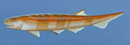
 (24 kb) The presence of spines, however, tells us that these fish were really acanthodians, not actinopterygians like anchovies.
Triazeugacanthus ranged from half a centimetre to six centimetres long, and each fin – with the exception of the caudal fin – contains a stout spine, which is the diagnostic feature of the group. The dorsal fin is set very far back, and the anal fin a little bit more forward. It had pelvic and pectoral fins, and between them a small pair of spines. Like all acanthodians, Triazeugacanthus had an epicercal tail.
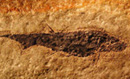 (116 kb)Triazeugacanthus was the most abundant acanthodian species in the Miguasha paleoestuary. Large concentrations of up to 600 fish per square meter along some laminite surfaces imply very high mortality rates provoked by as yet unknown phenomena.
The species had relatively large scales for its size, and a lateral line – typically the sensory organ of a fish – can be seen through the scales, running along the entire body length. A simple magnifying glass is often enough to see the otoliths (ear bones). Located in the inner ear of most fish, these small bones are responsible for equilibrium. There are six bones in Triazeugacanthus, three in each ear, indicating they had three semi-circular canals. This would have given these fish a refined sense of movement and three-dimensional position like all fish that are good swimmers. The particular characteristic suggests that acanthodians were closely related to bony fish.
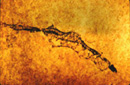 (60 kb)In 1935, the British paleontologist W. Graham-Smith published his descriptions of a small enigmatic Miguasha species he named Scaumenella mesacanthi. This species seemed closely related to Triazeugacanthus because both were found in equal abundance within some sedimentary layers. The fossils consisted of thin traces of carbon, which led Smith to assume that Scaumenella was a very primitive vertebrate. Other researchers suggested alternative interpretations for the animal, such as ostracoderm larvae, prochordata, or other invertebrates with morphologies similar to vertebrates.
 In 1985, a detailed study confirmed that Scaumenella were, in fact, small Triazeugacanthus at various stages of decomposition. One of the features that helped solve the mystery was the identical otoliths. The name Scaumenella was withdrawn, but the term “scaumenellization” is still used to describe this type of decay in Miguasha fish.




Title: Triazeugacanthus affinis
Author: Illustration by François Miville-Deschênes
Sources: Parc national de Miguasha
Year: 2003
Description:
This small species was very abundant in the ancient Miguasha estuary.
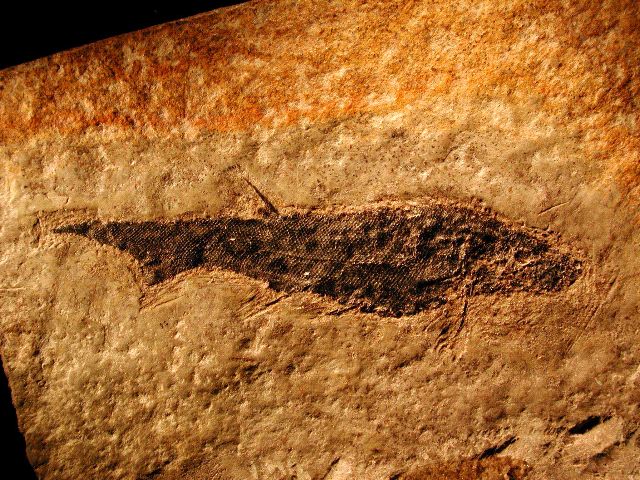
Title: Specimen of Triazeugacanthus affinis
Author: Parc national de Miguasha
Sources: Parc national de Miguasha
Year: 2002
Description:
This species ranges in length from 1 to 6 centimetres. The diagnostic acanthodian spines are evident in the specimen shown here.
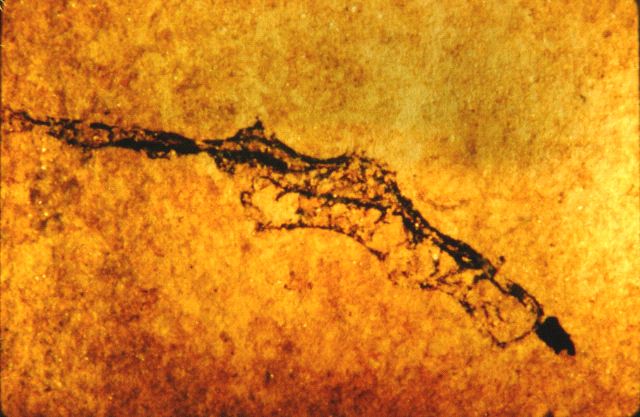
Title: Scaumenella mesacanthi
Author: Parc national de Miguasha
Sources: Parc national de Miguasha
Year: 1985
Description:
The decomposed remains of little Triazeugacanthus affinis, described in 1935 under the name of Scaumenella mesacanthi because it was though they represented a new species. Although it was later shown that they were not, the term “scaumenellization” is still used to describe fossil acanthodians at Miguasha that were preserved in a fairly advanced state of decomposition.
