
Erik Jarvik and the Prince of Miguasha
Eusthenopteron foordi is nicknamed The Prince of Miguasha, not only because it holds one of the foremost places in the evolution and understanding of vertebrates, but also because it helped bestow worldwide recognition upon Miguasha during the 20th century.
 (48 kb)Researchers from all over the world have studied Eusthenopteron, but the Swedes have a special place in the history of this fish. In particular, Professor Erik Jarvik dedicated sixty years of his life to studying Eusthenopteron, and published descriptions that were unequalled in their accuracy and realism. Not only is the skeleton well known, but also such details as the shape of the brain, the placement of the main nerves and blood vessels, the point of insertion of the muscles, etc.
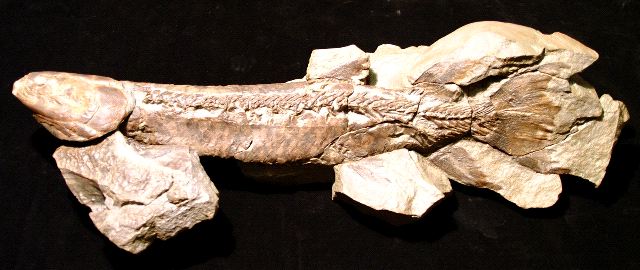
This vast wealth of knowledge is almost entirely due to a single specimen, the famous P.222, which was acquired by the Swedish Natural History Museum in Stockholm. Discovered during dynamite work in preparation for the construction of the Miguasha quay, the Swedes acquired the specimen through Joseph Landry for the sum of $50 Canadian, and it was shipped to Sweden in 1925.
 (48 kb)Researchers in Stockholm were thrilled by the incredible preservation of the specimen. At 53 cm long, its body still had a rounded shape and its head was almost complete, with the exception of a small part of the snout that was missing. After removing the fossilized scales from its surface, they could see the entire skeleton inside, held perfectly in place by its shroud of rock. If not for the stony texture, the specimen could have mistaken for a recently killed fish.
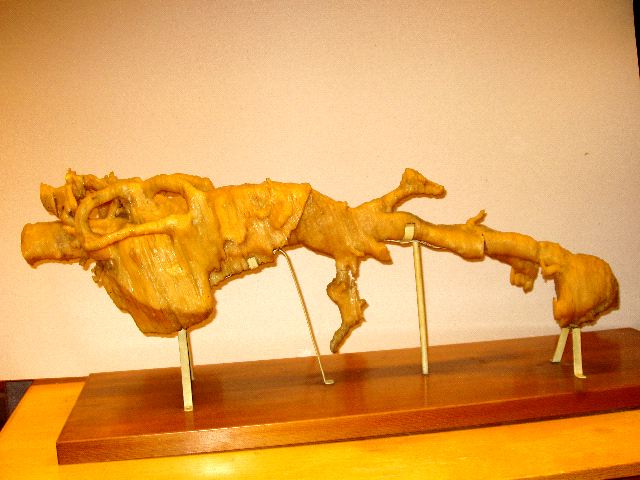
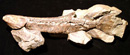 (40 kb)Erik Jarvik and his mentor, Erik Stensiö, decided to study the interior of the skull of this exceptional specimen by a process called serial sectioning. The method consisted of grinding away the specimen layer by layer, removing 0.2 mm of the fossil at a time, and drawing the exposed surface. The sectioning gradually wore down the entire skull, but the 530 drawings made during the process allowed researchers to reconstruct the head in three dimensions with wax, and to meticulously study everything on the surface and interior, right down to the tiniest details.
Twenty-five years of work on specimen P.222 provided a virtually complete morphology of Eusthenopteron’s skull, gills, palate bones, nasal capsules, etc. One of the most significant anatomical details revealed by Jarvik’s study was in the snout of the fish. The cross-sections made it possible to observe that the two nasal capsules, the little cavities in the interior of the snout, were not only linked to the outside by external nostrils, but also opened into the interior of the palate via internal nostrils. Identical orifices, called choana, are present in the fossils of primitive tetrapods. The presence of choana in Eusthenopteron strengthens the link between this sarcopterygian fish and terrestrial vertebrates.
Studies continue to this day on Eusthenopteron. Jarvik’s work is now pursued using new research techniques that include scanners and other non-destructive methods, which allow specimens to be preserved intact.
More than 200 articles were published on this species by researchers around the world. Thanks to all this diligent work, Eusthenopteron has the best known anatomy of any vertebrate fossil.
Interview with Erik Jarvik
 Open this page with video (6,5mo)
Note : For best viewing of this site, you will need this plugins: QuickTimeDownload QuickTime
Description de l’image
Dr. Erik Jarvik strolling along the bank and answering a reporter’s questions.
Reporter
I would like to kwow what is your feeling to be here after so many years of work on the Eusthenopteron ?
Dr. Erik Jarvik
Yes, I have had a dream to go here in many years, to see this marvelous site where the fish is come, which I am working with, all my life, for almost 50 years… I did not want to find any fossils here because I was in a group of 100 persons and as people picked up fishes I know rare. But in 1922, when… was collected here then they could collect everyday very beautiful species but it is not possible anymore. But I would like to walk and I walk along this bay to the end, 13 km I think. It was marvellous to see all these fishes coming from… so I did not want to collect my fossils here, just to walk, it was splendid.
Reporter
Did you find one ?
Dr. Erik Jarvik
No I did not find one. I did not look for one because we have plenty of fossils here.
Journaliste
What was the importance of Eusthenopteron for you ?
Dr. Erik Jarvik
Yes, it is, Eusthenopteron yes is remarquable in one way, it is extremely well preserved. So you can get all intern anatomy and then you can restore progress and the head and them you can compare with recent aninals and you will find it is related to women and men in many ways. So therefore it is fossil fish that is best known because of excellent stages of preservation of material. So that is important.
Reporter
Thank you very much professor.
Site map | Feedback | Links | Sources | Credits
Erik Jarvik and the Prince of Miguasha
<< Local fossil hunters | The birth of the Miguasha project >>



Title: Erik Jarvik and Marius Arsenault
Author: Parc national de Miguasha
Sources: Parc national de Miguasha
Year: 1991
Description:
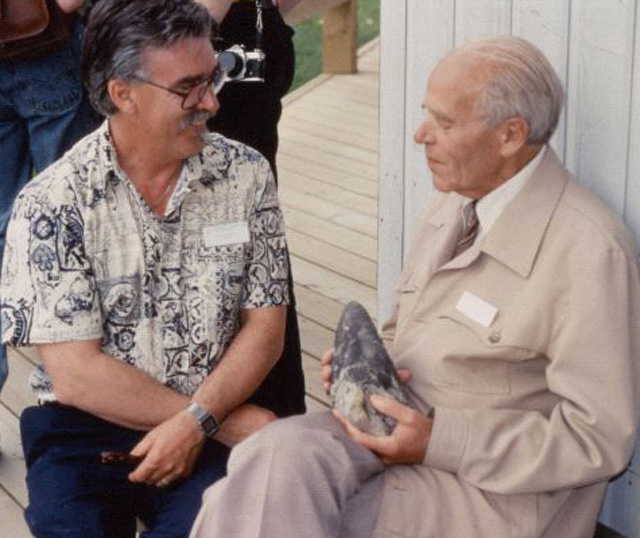
Marius Arsenault with Erik Jarvik who is holding the skull of Eusthenopteron foordi. The photo was taken at Miguasha in 1991 during the 7th International Symposium on the Studies of Lower Vertebrates. Even though Professor Jarvik dedicated his life to the study of this extinct fish that he made so famous, he was never able to touch the rocks that entombed Eusthenopteron until he took part in this international event.
Title: Erik Jarvik’s wax model
Author: Marius Arsenault
Sources: Marius Arsenault
Year: 2005
Description:
Erik Jarvik’s wax model showing the cavities and canals inside the neurocranium of Eusthenopteron foordi. The model was created using information gathered by serial sectioning the famous P-222 specimen. Professor Jarvik’s work spanned 25 years! The original sample is kept at the Swedish Museum of Natural History in Stockholm.
Title: The famous specimen P-222
Author: Parc national de Miguasha
Sources: Parc national de Miguasha
Year: 2003
Description:
The famous P-222 specimen of Eusthenopteron foordi before its skull was destroyed by serial sectioning. Erik Jarvik had already removed the scales to examine the spinal column. The photo is of a replica of the specimen created by the master mould maker Hiromi Maruo using an original mould kept at the National Science Museum of Tokyo in Japan.
