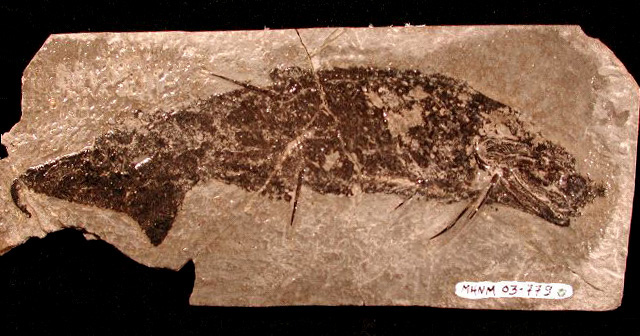
Homalacanthus
Homalacanthus concinnus is the largest acanthodian to have swum in the waters of the Miguasha estuary.
 (28 kb) At 30 centimetres long, it was a giant version of Triazeugacanthus affinis. It was distinguished from its little cousin by the absence of a pair of intermediate spines between the pectoral and pelvic fins.
 (72 kb)The species is common in some laminite layers, but is rarely found in limestone concretions. A number of specimens have been preserved well enough to provide information about the digestive system, which was extremely simple. Barely a quarter the length of the fish, it formed a line that started at the pectoral girdle and ran just below the lateral line before dropping down to the level of the pelvic fins. Some specimens have been discovered with this digestive tube filled with the little crustaceans Asmusia membranacea.
 (56 kb)A specimen of Eusthenopteron was even found with a Homalacanthus down its throat. This direct evidence of the feeding relationship between two Miguasha estuarine species was, in 1982, the subject of the first scientific article on Miguasha written by a Quebecer, former park director Marius Arsenault. After 100 years of study by specialists from elsewhere, a wave of research by local scientists was finally underway and continues in earnest to this day.
(28 kb) At 30 centimetres long, it was a giant version of Triazeugacanthus affinis. It was distinguished from its little cousin by the absence of a pair of intermediate spines between the pectoral and pelvic fins.(72 kb)The species is common in some laminite layers, but is rarely found in limestone concretions. A number of specimens have been preserved well enough to provide information about the digestive system, which was extremely simple. Barely a quarter the length of the fish, it formed a line that started at the pectoral girdle and ran just below the lateral line before dropping down to the level of the pelvic fins. Some specimens have been discovered with this digestive tube filled with the little crustaceans Asmusia membranacea.(56 kb)A specimen of Eusthenopteron was even found with a Homalacanthus down its throat. This direct evidence of the feeding relationship between two Miguasha estuarine species was, in 1982, the subject of the first scientific article on Miguasha written by a Quebecer, former park director Marius Arsenault. After 100 years of study by specialists from elsewhere, a wave of research by local scientists was finally underway and continues in earnest to this day. 


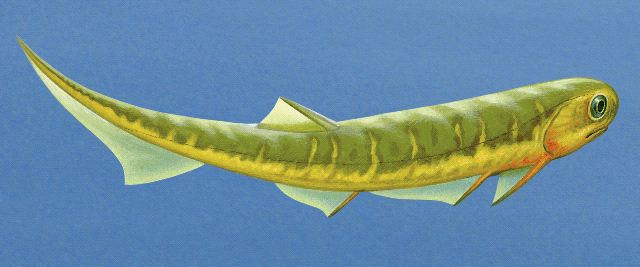
Title: Homalacanthus concinnus
Author: Illustration by François Miville-Deschênes
Sources: Parc national de Miguasha
Year: 2003
Description:
Homalacanthus concinnus was the biggest acanthodian to swim in the waters of the ancient Miguasha estuary. It grew up to 30 centimetres long.