Biostratigraphy
The age assigned to the Escuminac Formation is based mainly on the fossils it contains.
 (84 kb) By comparing its animal and plant assemblages with other Devonian assemblages, it was possible to assign a Frasnian (Upper Devonian) age to the fossil-bearing portion of the Miguasha cliff.
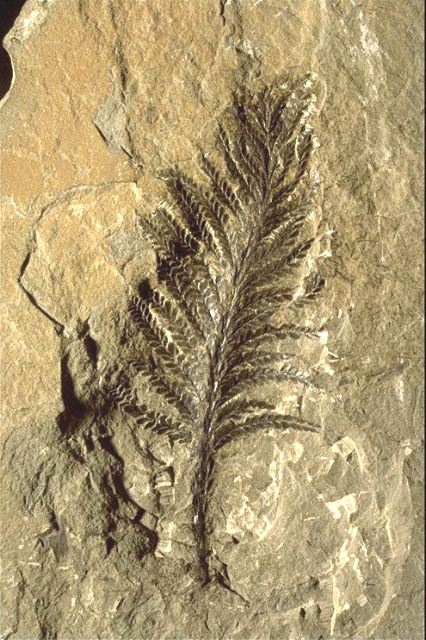
Assigning this Upper Devonian age relied for a long time on the presence of the plant Archaeopteris and certain fish species. Archaeopteris is characteristic of the Upper Devonian around the world, and fish species like Bothriolepis, Plourdosteus and Eusthenopteron are also typical of Upper Devonian layers, although it is now known that these animals also existed in older Devonian layers. In order to place the Escuminac Formation into international Devonian standards with even more precision, it was necessary to study Miguasha’s fossil spores.
 (52 kb)Plants evolved very rapidly during the Devonian, rapidly enough that their spores can be used to subdivide the larger divisions of this geological period into successive “spore zones”, each one characterized by diagnostic plant species. The spores retrieved from the Escuminac Formation include the characteristic species of an assemblage known as Archaeoperisaccus ovalis-Verrucosisporites bulliferus, which is named after the species that define it. Using this information, the Escuminac formation is now attributed to the middle part of the Frasnian Age. This corresponds to an approximate age of 380 million years according to a time-scheme that incorporates the most recent absolute dates adopted by the International Union of Geological Sciences (IUGS).
(84 kb) By comparing its animal and plant assemblages with other Devonian assemblages, it was possible to assign a Frasnian (Upper Devonian) age to the fossil-bearing portion of the Miguasha cliff.Assigning this Upper Devonian age relied for a long time on the presence of the plant Archaeopteris and certain fish species. Archaeopteris is characteristic of the Upper Devonian around the world, and fish species like Bothriolepis, Plourdosteus and Eusthenopteron are also typical of Upper Devonian layers, although it is now known that these animals also existed in older Devonian layers. In order to place the Escuminac Formation into international Devonian standards with even more precision, it was necessary to study Miguasha’s fossil spores.
(52 kb)Plants evolved very rapidly during the Devonian, rapidly enough that their spores can be used to subdivide the larger divisions of this geological period into successive “spore zones”, each one characterized by diagnostic plant species. The spores retrieved from the Escuminac Formation include the characteristic species of an assemblage known as Archaeoperisaccus ovalis-Verrucosisporites bulliferus, which is named after the species that define it. Using this information, the Escuminac formation is now attributed to the middle part of the Frasnian Age. This corresponds to an approximate age of 380 million years according to a time-scheme that incorporates the most recent absolute dates adopted by the International Union of Geological Sciences (IUGS). Site map | Feedback | Links | Sources | Credits
Biostratigraphy
<< Localization systems | An ancient estuary >>