
Witnesses to evolution
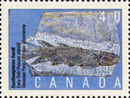
 (44 kb)The theory of the evolution of species is based on studies of the living world in which it is possible to observe rapid changes, whether they be in the evolution of a population’s genetic baggage, controlled crossbreedings that “create” new races and varieties, or the disappearance of species, which is itself an integral part of the evolutionary process of life. The bulk of the evidence for the theory, however, is found in the fossil record.
 Since its discovery, the Miguasha site has played an important role in the development of evolutionary theories, particularly those concerned with vertebrates. Early on, specific species provoked changes in the various schools of thought on evolution, and of these, Eusthenopteron foordi is by far the most famous. It is this fish that gave rise to the idea that we—as vertebrates, tetrapods, humans—have distant aquatic origins within that animal group!
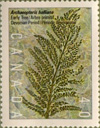 (44 kb)Species that occupied important places in the evolutionary history of plants are also found at Miguasha. Once abundant along the shores of this ancient waterway, Archeopteris, the earliest known tree, helped build the planet’s first forests, and its presence signalled the appearance of conifers soon thereafter.
Site map | Feedback | Links | Sources | Credits
Witnesses to evolution
<< The history of the Devonian System | A lost world >>



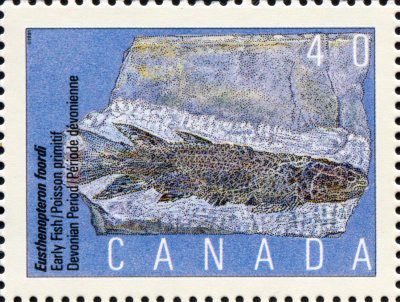
Title: A stamp featuring Eusthenopteron foordi
Author: Issued by Canada Post
Sources: Parc national de Miguasha
Year: 1991
Description:
On June 9, 1991, Canada Post issued this stamp featuring one of the keystone animals in vertebrate evolution, Miguasha’s Eusthenopteron foordi. This Upper Devonian creature launched the theory that a group of ancient fish gave rise to the tetrapods – the first land-dwelling vertebrates – and therefore to us.

Title: Stamp featuring Archaeopteris
Author: Issued by Canada Post
Sources: Parc national de Miguasha
Year: 1991
Description:
This stamp issued by Canada Post on June 9, 1991, features the primitive Devonian tree Archaeopteris. It was the main constituent of the planet’s first forests and is considered to be the ancestor of conifers. The illustration was made using a specimen kept at the Natural History Museum of the Parc national de Miguasha.
