
The closing of an ocean

 (84 kb) Appalachian history is intimately linked to the closure of the Iapetus, an ancient ocean that occupied a position roughly equivalent to that of the North Atlantic today. The Iapetus Ocean lasted for more than 150 million years (150 Ma), from the end of the Precambrian Era to the middle of the Paleozoic.
  (48 kb)This ancient ocean, born a little more than 540 million years ago at the end of the Precambrian, was bordered to the east by Baltica (present-day Europe) and to the west by Laurentia (the Canadian shield of North America). The convergence and collision of these continental masses led to the gradual closure of the Iapetus Ocean from Ordovician to Devonian time. Under the compressive forces of the initial Taconic tectonic phase during the Ordovician Period, the ancient ocean floor of the Iapetus and its partially submerged volcanic arc were joined to the edge of Laurentia. The ocean then closed completely during the Acadian tectonic phase, when Baltica finally collided with Laurentia. It was during the peak of the Acadian episode, at the beginning of the Middle Devonian (around 385-395 Ma), that the last arm of the Gaspesian sea, an extension of the Iapetus Ocean, finally closed. The resulting continental assemblage formed a megacontinent called Euramerica, and included the small accreted microcontinent of Avalonia that once sat in the middle of the Iapetus Ocean. The remains of this long-vanished landmass now form the Avalon Peninsula of Newfoundland.
The mountains of the Gaspé region consist mainly of sedimentary and volcanic rocks that tell the Cambrian to Devonian history of the Iapetus from a North American point of view. These mountains were still rising during the Upper Devonian, and their erosion provided the sediments that fed the Escuminac Formation. Around the same time, another ocean further south, the Rheic Ocean, was also closing as the Gondwana continental landmass, which included ancient South America and Africa, slowly merged into Euramerica to form Pangea. The reddish continental sediments laid down during the Carboniferous Period in Quebec’s Baie des Chaleurs, along the southern Gaspé shore, are testimony to the final tectonic jolts that gave the Appalachians their last heave upwards during the Alleghanian phase.
Site map | Feedback | Links | Sources | Credits
The closing of an ocean
<< The Gaspé Peninsula: A world of oceans and mountains | The birth of the Appalachians >>



Title: Mount Albert
Author: Mathieu Dupuis
Sources: Parc national de la Gaspésie
Year: 2005
Description:
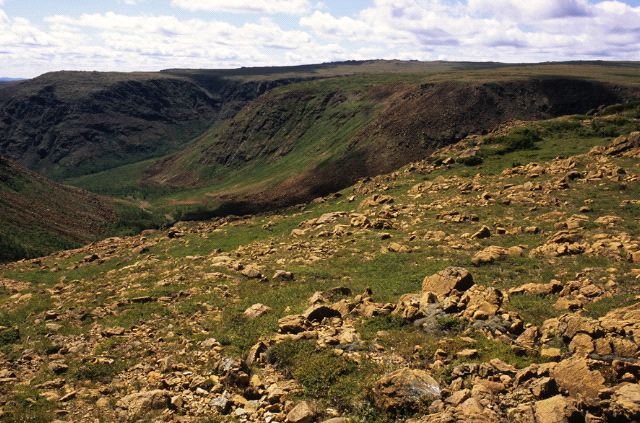
The upper plateau on Mount Albert at the Cuve du Diable (roughly translated as the “Devil’s Cistern”) in the Parc national de la Gaspésie. Lying at the heart of the Chic-Choc Mountains, Mount Albert rose up from the depths of the ancient Iapetus Ocean. It formed during the Taconic Orogeny at the end of the Ordovician Period around 450 million years ago.
Title: Major geological domains of the Gaspé Peninsula.
Author: François Bienvenue
Sources: Parc national de Miguasha
Year: 2007
Description:
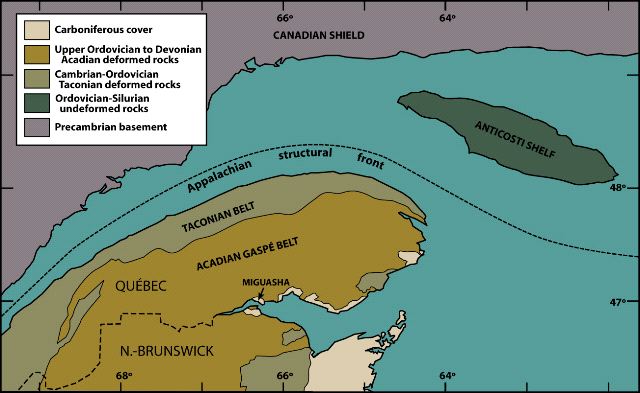
Two major tectonic domains characterized the Appalachian Mountains of the Gaspé Peninsula. The northern part of the region came into being during the Ordovician during a first phase of Taconic accretion, while in the southern part, sediments were deformed mainly during the Devonian, during the Acadian accretion.
