
Miguasha fossils around the world
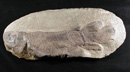
 (60 kb) Of some 19,000 vertebrate specimens officially collected from the Miguasha site, about 8,500 – or approximately 44% of all finds – are kept outside Quebec.
Although the majority of fossils (just over 10,000) are housed in the Natural History Museum of the Parc national de Miguasha, some other collections are worth mentioning.
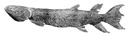 (32 kb)The five largest are: the private collection of William Graham-Smith (Boars Hill, England), with 2,043 Miguasha specimens (10%); the Naturhistoriska Riksmuseet in Stockholm, Sweden, with 1,287 specimens (6%); the Musée de géologie René-Bureau at the Université de Laval in Quebec City, with 923 specimens (4%); the Museum of Natural History in London, England, with 819 specimens (just under 4%); and the New York State Museum in Albany, New York, with 648 specimens (3%).
 (68 kb)Paleontologists and students accustomed to Miguasha can feel quite at home when they get to the "Scaumenac Bay" section of these great collections. It is a proud moment to see the places of honour accorded these fossils in the display cases and drawers of such respectable institutions, especially considering that their human histories are usually much longer than Miguasha’s.
Site map | Feedback | Links | Sources | Credits
Miguasha fossils around the world
<< A World Heritage Site | The geology craze of the 19th century >>



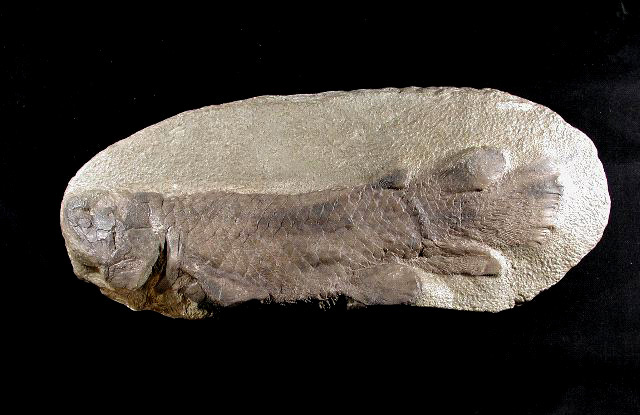
Title: Holoptychius jarviki
Author: Parc national de Miguasha
Sources: Parc national de Miguasha
Year: 2002
Description:
The type specimen of the porolepiform Holoptychius jarviki was discovered at Miguasha by the American paleontologist William Patten in 1912. It is kept at the American Museum of Natural History in New York City.
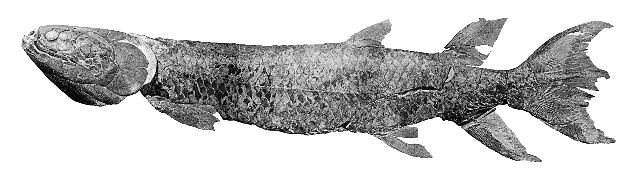
Title: Specimen P-222
Author: Not available
Sources:
Year: Not available
Description:
The famous P-222 specimen described in detail by Erik Jarvik and kept at the Swedish Museum of Natural History in Stockholm. It was sent to Erik Stensiö by Joseph Landry, a Miguasha resident, in 1925. The three-dimensional fossil skull of Eusthenopteron foordi was ground down a millimetre at a time to reveal its internal anatomy.
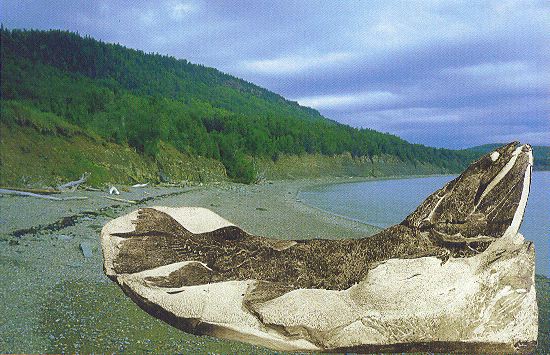
Title: A Eusthenopteron foordi specimen at the Cleveland Museum of Natural History
Author: Bruce Frumker (specimen) and Fred Klus (cliff)
Sources: Parc national de Miguasha
Year: 1996
Description:
This specimen of Eusthenopteron foordi was featured on the cover of the book “Devonian Fishes and Plants of Miguasha”. It was discovered in a large sandstone block at the foot of the cliff by Allen Parent in 1966 and is now kept at the Cleveland Museum of Natural History. Image taken from H.P. Schultze and R. Cloutier (editors), 1996. Devonian Fishes and Plants of Miguasha, Quebec, Canada, Verlag Dr. Friedrich Pfeil.
