
Escuminaspis
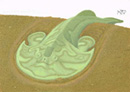
 (68 kb) What is now considered to be a single species was at one time thought to be three. It was recently recognized, however, that these various “species” were really the same animal at different stages of growth.
Unlike other more ancient osteostracans, Escuminaspis featured an unconsolidated head shield, meaning that its bony covering was made of hundreds of very small disjointed polygonal platelets called tesserae. Over the course of the animal’s life, the tesserae grew at the same pace as the fish without ever welding together.
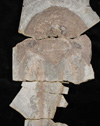 (48 kb)The head shield of Escuminaspis laticeps is almost perfectly round, as is its ventral oralobranchial opening. The size of the shield ranges from 3 to 30 cm in recovered specimens. Escuminaspis is one of the few species of osteostracan whose trunk and fin morphologies are known to us. The entire body reached up to 60 cm long and was equipped with two paddle-shaped pectoral appendages, a dorsal fin, and a terminal caudal fin (tail) with an upward pointing axis. It was thought for a long time that the head shield lacked lateral sensory pathways, but a newly discovered specimen clearly shows that it was equipped in this regard. It is still assumed that its cousin Levesquaspis did not posses this feature.
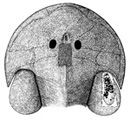 (68 kb)Under their thinly scaled skin, the pectoral appendages of Escuminaspis reveal a trait that is unique among jawless fish: the presence of a single flat and elongated internal support structure made of partially calcified cartilage. A similar structure has been observed in present day gnathostomes during the very early stages of pectoral fin development, before the fins divide into several fan-like elements.
This fact, combined with other characteristics, such as the epicercal tail and the presence of cellular bone and sclerotic rings around the eyes, links osteostracans more closely to the gnathostomes.



Title: An osteostracan
Author: Illustration by François Miville-Deschênes
Sources: Parc national de Miguasha
Year: 2000
Description:
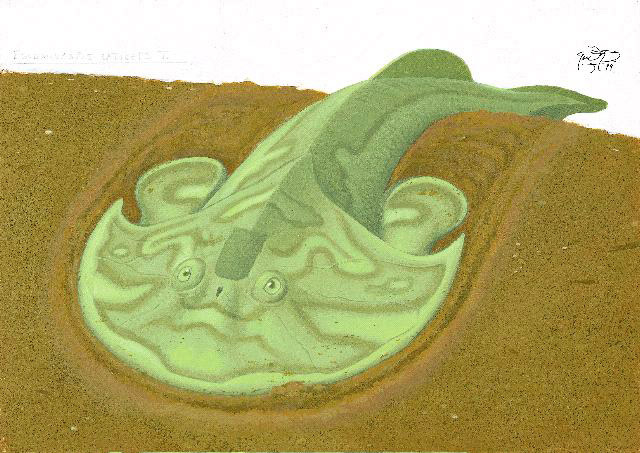
Osteostracans were bottom-dwelling fish characterized by a flattened head with a semi-circular shape.
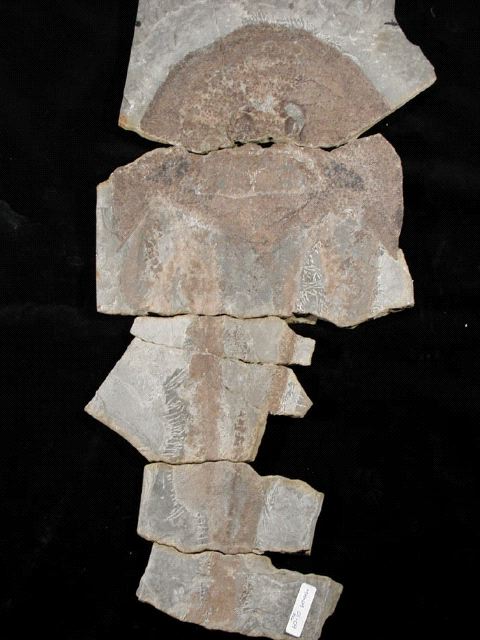
Title: Escuminaspis laticeps
Author: Parc national de Miguasha
Sources: Parc national de Miguasha
Year: 2001
Description:
This complete specimen of the osteostracan Escuminaspis laticeps from the Escuminac Formation displays its paddle-shaped pectoral fins and the hind part of its body.
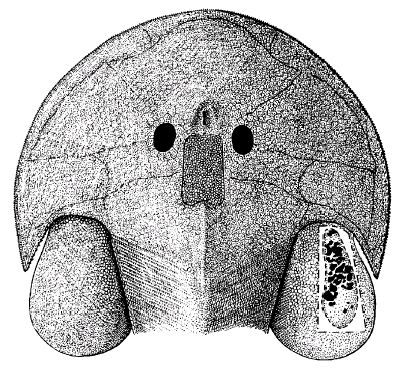
Title: Reconstruction of the front part of Escuminaspis laticeps
Author: Illustration by Philippe Janvier
Sources: Parc national de Miguasha
Year: 2005
Description:
An internal support structure was observed in the paired pectoral fins of this osteostracan. The partially calcified cartilaginous structure is a single element with an elongated flattened shape.
