
Toward the first tetrapods

 (40 kb) A tetrapod is an air-breathing animal that has four legs, or has descended from a four-legged animal. Frogs, penguins, snakes, baboons, swallows, porpoises and even humans are all tetrapods. They live in nearly every ecological niche.
Tetrapods evolved from fish. It was long believed that tetrapods developed because fish succumbed to selective pressures that favoured life in the open air. We now know that the first tetrapods were entirely and exclusively aquatic: they could not linger on dry land despite having lungs and four feet with digits. For example, Acanthostega, found in Upper Devonian layers in Greenland, had ribs that were not sufficiently developed to support the weight of its body out of water. It would have collapsed on the first attempt, rendered unable to breathe. Ichthyostega compensated by developing a stronger ribcage that enabled it to overcome the burden of gravity.
 (60 kb)A few million years later, when the first tetrapods worthy of the name began to walk on land, they were still dependent on their aquatic habitat, at least for reproduction. Their eggs, not so different from those of fish, had to remain submerged to survive. This is still the case for amphibians like frogs and salamanders. Their small size allows them to escape the drawbacks of gravity out of water, and they spend most of their time in the water. It was only with the appearance of impermeable membranes like the amnion (a membranous sac that surrounds and protects the embryo), that eggs could be safely laid on dry land by reptiles: a new group of tetrapods that appeared around 315 million years ago (315 Ma). Existing today as snakes, turtles, alligators and lizards, reptiles enjoyed considerable diversity when they included the celebrated dinosaur group between 230 and 65 Ma.
It was 220 Ma ago, in the shadow of the first dinosaurs, when a small group of reptiles, the synapsids, evolved into a new tetrapod form: mammals. It was only much later, once the dinosaurs became extinct and several ecological niches were left vacant, that mammals could express their true evolutionary potential.
Are dinosaurs extinct? Not really... 150 million years ago, some became covered in feathers and developed winged flight, giving rise to birds.
Each of these four great groups of tetrapods – amphibians, reptiles, mammals and birds – knew various evolutionary successes and failures over the course of time. They scattered across all regions of the Earth (some even returning to the oceans), and now interact with each other – and with all other living creatures – in the great ecosystem that we call the biosphere.
The evolutionary success of the tetrapods should not make us forget their ancient aquatic origins at the end of Devonian time. Paddling in mud near the soft, bushy banks of equatorial deltas and estuaries, a group of fish, the elpistostegalians, were poised to give rise to the first vertebrates with toed feet. Among these tetrapod forerunners were Panderichthys, now found fossilized in Latvia, Tiktaalik, in the Canadian Arctic, and Elpistostege, at Miguasha. The gradual conquest of land by vertebrates represented a major event in the history of the animal kingdom and raises an important question: what was the selective advantage of the first tetrapods? In other words, why did they leave the water? The land at that time, invaded by inedible plants and a few rare arthropods, offered little in the way of resources for vertebrates the size of a small crocodile, greedy for protein and with a talent for catching fish. It is plausible that, faced with competition from other predator fish of the same size like Eusthenopteron or Holoptychius, the tetrapod forerunners ventured on land to guard their prey. To seize a placoderm like Bothriolepis, a very common fish, and be able to devour it quietly in a place out of reach of envious competitors was undoubtedly a compelling advantage. It could finally eat in peace in the Devonian world where the calmest place – paradoxically – was outside the “silent world” of water!
Interview with Philippe Janvier
Picture Description
Still picture of a prehistoric man followed by an interview with Mr. Philippe Janvier. At the end of the interview, we see a man walking on the moon.
Philippe Janvier
Take, for example, the invention of fire. This is particular to man. As far as I am aware, he is the only animal capable of making fire. One could not have invented fire in the water. Therefore, one had to be out of the water to invent fire.
If man had not invented fire, there would have been no rockets. Without rockets, man would have been unable to explore space. I believe that the conquest of space is inseparable from leaving the water and that leaving the water 350 million years ago was the first step towards the moon.
Astronaut on the moon
Oh My God! It’s unbelievable!
 Download QuickTime
Site map | Feedback | Links | Sources | Credits
Toward the first tetrapods
<< The diversification of fish | The animals of Miguasha >>



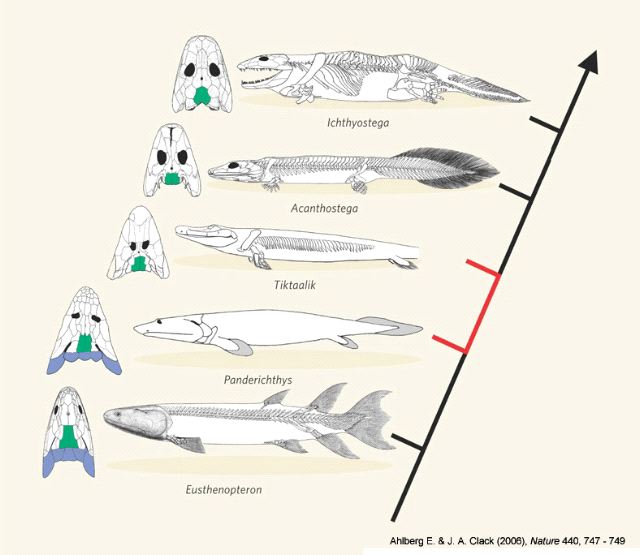
Title: The evolution of sarcopterygian fishes towards the first tetrapods
Author: Figure taken from Ahlberg and Clack 2006, Nature 440, 747-749.
Sources: Nature 440
Year: 2006
Description:
Two Miguasha fish hold an important place in the evolution of sarcopterygian fishes towards the first tetrapods. For nearly a century, the osteolepiform Eusthenopteron has been considered an intermediate link in this transition. However, elpistostegalian fishes that include Panderichthys, Elpistostege and Tiktaalik resemble the first four-limbed vertebrates even more closely. The Elpistostege of Miguasha is considered to be an animal similar to Tiktaalik, an animal recently discovered in the Canadian Arctic. Figure taken from Ahlberg and Clack 2006, Nature 440, 747-749. With the permission of the Nature Magazine.
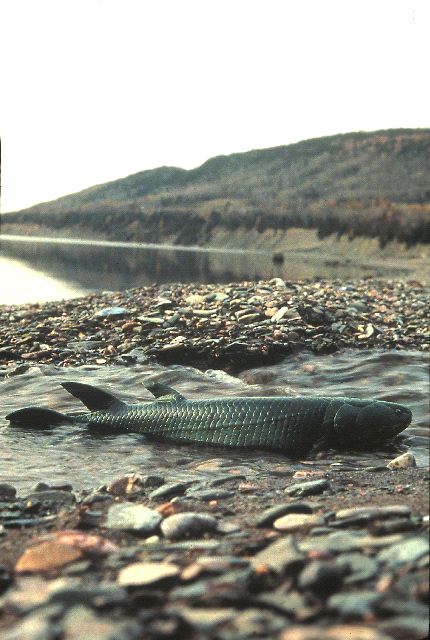
Title: Eusthenopteron foordi
Author: Jean-Pierre Sylvestre
Sources: Parc national de Miguasha
Year: 1997
Description:
It was during the Devonian Period that sarcopterygian fish gave rise to the first terrestrial vertebrates. Eusthenopteron foordi (shown here) was long thought to be the transitional animal between fish and tetrapods, sharing features with both, but recent discoveries have shown that the elpistostegalians are even more closely related to four-legged vertebrates.
