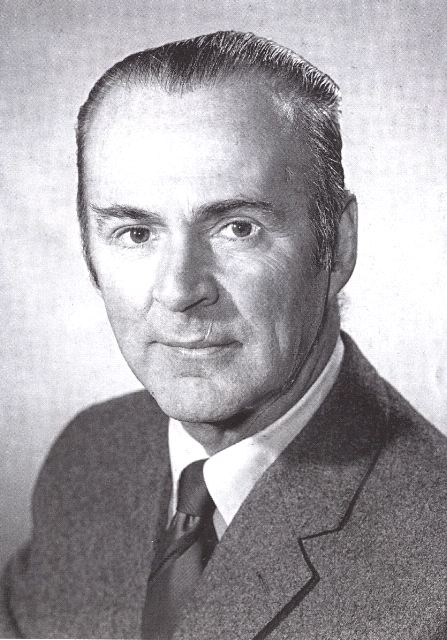
The birth of the Miguasha project
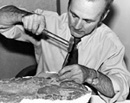
 (76 kb) Brothers and priests were devoted to botany, chemistry and entomology, and founded schools and teaching faculties for the natural sciences, many of which later evolved into the first Quebec universities. Geologists and paleontologists were rather rare among these pious men, which may explain why no one in Quebec’s academic elite seemed to be aware that scientists from the United States and Europe were coming to collect fossils at the Miguasha cliff site.
Things changed in 1937 when two geologist-priests, Father Léo-Georges Morin of the Université de Montréal, and Abbot J. W. Laverdière of the Université Laval à Québec, continued travelling into the Gaspé region after completing geological surveys between Rivière-du-Loup and Matane. Arriving at Baie-des-Chaleurs, their curiosity was piqued by a small sign announcing “Fossils for sale” along the side of the road. Intrigued, they arrived at the home of the Plourde family and, according to all accounts, were the first French Quebecers to buy Miguasha fossil specimens, spending $2.50.
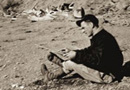 (72 kb)After a preliminary examination of the fossiliferous cliff, they quickly realized its great scientific importance. They learned through the local people that foreign researchers arrived almost every year to collect fossils from the sedimentary rocks. With a little luck, they would have even crossed paths with Graham-Smith and Westoll, two Englishmen who had just left with several crates of specimens.
 Upon returning to Quebec City, the two men alerted the Ministry of Mines and Fishing and managed to obtain a small budget to send Quebec’s first delegation into the field. And so it came to be that a newly hired and self-taught geologist by the name of René Bureau was sent to Miguasha to establish a collection of fossils.
Ably assisted by Euclide Plourde, René Bureau spent most of October of 1937 hunting through the cliff’s rocks, and managed to fill several crates of fossils that he shipped to the Ministry of Mines in Quebec City. Several years later, these fossils were handed over to the geological museum of the Université Laval, at the same time that Mr. Bureau became Adjoint Curator of the museum.
 (64 kb)By the end of the 1930’s, René Bureau had alerted government officials to the pillage of fossils that was continuing in the Gaspé, and made the scientific community aware of the significant wealth hidden in the cliffs. But his efforts were in vain for many years. For Bureau, protecting the Miguasha site would be a long story of patience and stubbornness.
In the 1960’s, Bureau’s “Miguasha Project”, as he called it, made it back into the headlines. The project proposed that part of the cliff be provincially controlled and turned into a conservation zone, effectively preventing the wanton collection of fossils, and that a small museum be established to increase awareness of the site.
By the early 1970’s, the project was beginning to take shape. The governments were showing signs of interest, particularly in the face of rumours that American investors were looking into acquiring the land bordering the Miguasha cliffs. In 1972, realizing the importance of the site, the government of Quebec bought a series of lots that extended from the public road to the cliff where the Escuminac Formation outcropped.
In 1976, the government of Quebec asked the Université du Québec à Rimouski to assemble the first official field team, and to undertake fossil digs and lay the basic foundations of a museum. In 1977, Marius Arsenault, a Gaspesian newly instructed in paleontology, was named head of the team and would go on to manage the site and park for more than 25 years.
In June of 1978, the museum welcomed its first visitors, lured by the fabulous specimens. Fossil digs, laboratory work and the formation of a Quebec collection were also taking place on site. In 1985, the site and its museum became a conservation park, further protecting the fossiliferous rocks for present and future generations.
René Bureau: 1941
Picture Description
René Bureau and his wife on their honeymoon in 1941 at the Miguasha cliff searching for fossils.
 Download QuickTime
Picture Description
René Bureau sitting near the cliff in the company of a reporter.
Reporter
The Miguasha site has been explored by strangers for many years. When did the government of Quebec decide to protect the site and oversee its exploitation?
René Bureau
Starting in 1937. At that time, the Department of Mining, a division of the Ministry of Mines and Fisheries, charged Abbot Laverdière, Director of the Institute of Geology of Laval, and Father Morin, Director of the Institute of Geology of Université de Montréal, to conduct a geological survey of the region between Rivière-du-Loup and Matane. At the end of the season, they decided to take a short vacation and tour the Gaspé Peninsula. They had never made the trip before. Arriving in the Miguasha area, they spied a sign indicating fossils for sale. They stopped and talked to a farmer nearby, luckily for them, Mr. Plourde. They purchased some fossils and learned that during the summer, a group of Britons from England had come and departed with a large collection of fossils.
The men were surprised and astounded to hear this. They understood that our fossils were being taken elsewhere and that here in Quebec this type of fossil was rare indeed.
Luckily, during their journey, they stopped in New Richmond where they met with Mr. L.A. Richard, then Deputy-Minister of Mines and Fisheries, and explained the situation to him. Upon his return to Quebec, Mr. Richard met with the Honourable Onésime Gagnon, Minister of Mines and Fisheries and MP of Matane under the Duplessis Government. They discussed the matter. Then, they the summoned Director Dufresne and asked me to attend their information session. There they charged me with mounting a collection of fossils for the Department of Mining of Quebec.
And that is how it all began!
Note: For best viewing of this site, you will need these plugins:Download QuickTimeSite map | Feedback | Links | Sources | Credits
The birth of the Miguasha project
<< Erik Jarvik and the Prince of Miguasha | The 1991 International Symposium >>




Title: René Bureau preparing a Miguasha fish fossil
Author: Not available
Sources: Parc national de Miguasha
Year: Not available
Description:
René Bureau extracting a fossil of Eusthenopteron foordi. René Bureau put together the first Quebec collection of Miguasha fossils, which is now kept at Quebec City’s Université Laval in a museum that bears his name.