Scaumenacia
Named after Scaumenac Bay (Baie d’Escuminac), the dipnoan fish Scaumenacia curta is the second most abundant sarcopterygian in the fossiliferous Escuminac Formation after Eusthenopteron foordi.
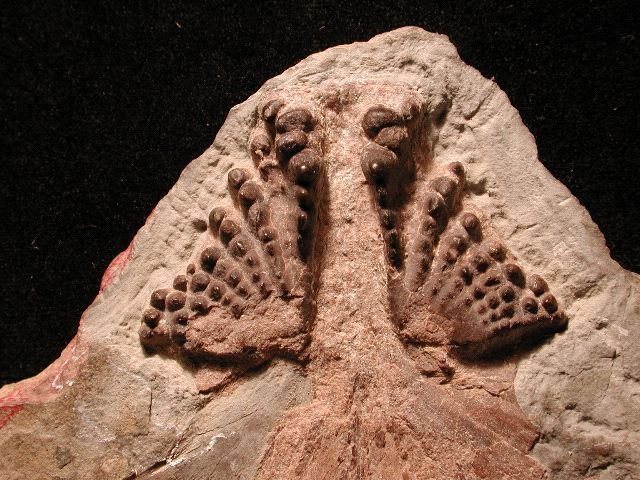
 (44 kb) Due to the large number of specimens, often complete, this species is one of the best known of all extinct dipnoi.
The species is represented by individuals of all sizes, ranging from young fish barely 1 cm long, to adults of 65 cm. This great range means that paleontologists can accurately reconstruct its entire growth sequence. The upper and lower dental plates of Scaumenacia are also well studied and display only slight variations in their pattern.
 (80 kb)The conditions for fossil preservation at Miguasha were favourable to Scaumenacia. For example, many skulls were preserved in three dimensions and show the complex pattern of the skull bones. In addition, some specimens were found with their meals still visible in the abdominal cavity. These stomach contents revealed a clear preference for Asmusia, a small crustacean protected by two shells. One such specimen, nicknamed La grande bouffe (a French reference to its enormous meal), had swallowed thousands before its death.
 (88 kb)Scaumenacia curta was capable of powerful acceleration, as demonstrated by the extreme length of its back fins: the second dorsal fin, epicercal caudal fin, and anal and pelvic fins all form an immense fan. The first dorsal fin consists of very short rays, but it only occupies a quarter of the animal’s body length. The paired fins (pectoral and pelvic) display an elongated, streamlined form. And rare for a fossil fish of this period, it had well-developed, ossified ribs.
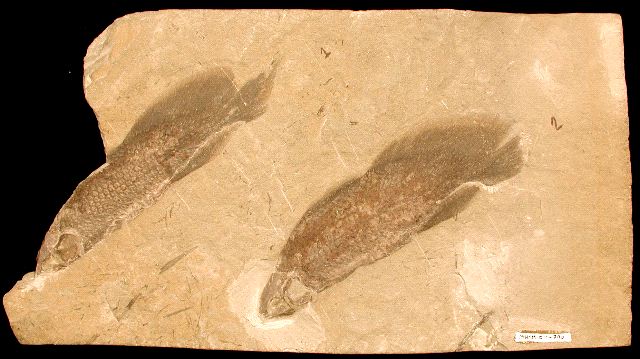
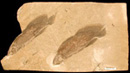
One of the fossiliferous rocks preserved at the museum contains 14 Scaumenacia specimens, all about the same length, suggesting that the species was gregarious, at least during some parts of its life.
 (52 kb)With its large, rounded scales, its stocky body and short snout, Scaumenacia’s physiognomy is in some ways reminiscent of its distant descendant Neoceratodus, Australia’s living lungfish.
(44 kb) Due to the large number of specimens, often complete, this species is one of the best known of all extinct dipnoi.The species is represented by individuals of all sizes, ranging from young fish barely 1 cm long, to adults of 65 cm. This great range means that paleontologists can accurately reconstruct its entire growth sequence. The upper and lower dental plates of Scaumenacia are also well studied and display only slight variations in their pattern.
(80 kb)The conditions for fossil preservation at Miguasha were favourable to Scaumenacia. For example, many skulls were preserved in three dimensions and show the complex pattern of the skull bones. In addition, some specimens were found with their meals still visible in the abdominal cavity. These stomach contents revealed a clear preference for Asmusia, a small crustacean protected by two shells. One such specimen, nicknamed La grande bouffe (a French reference to its enormous meal), had swallowed thousands before its death.(88 kb)Scaumenacia curta was capable of powerful acceleration, as demonstrated by the extreme length of its back fins: the second dorsal fin, epicercal caudal fin, and anal and pelvic fins all form an immense fan. The first dorsal fin consists of very short rays, but it only occupies a quarter of the animal’s body length. The paired fins (pectoral and pelvic) display an elongated, streamlined form. And rare for a fossil fish of this period, it had well-developed, ossified ribs.One of the fossiliferous rocks preserved at the museum contains 14 Scaumenacia specimens, all about the same length, suggesting that the species was gregarious, at least during some parts of its life.
(52 kb)With its large, rounded scales, its stocky body and short snout, Scaumenacia’s physiognomy is in some ways reminiscent of its distant descendant Neoceratodus, Australia’s living lungfish.


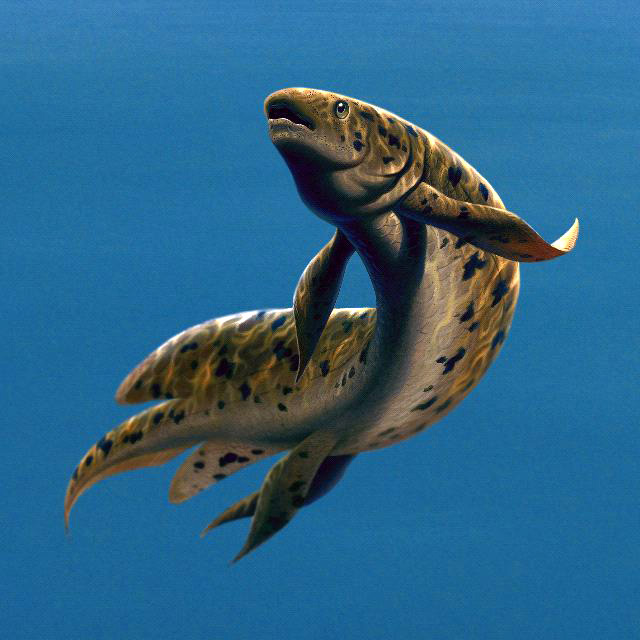
Title: Reconstruction of the Miguasha dipnoi Scaumenacia
Author: Illustration by François Miville-Deschênes
Sources: Parc national de Miguasha
Year: 2003
Description:
Miguasha’s dipnoi Scaumenacia displays some similarities in physiognomy with its distant offspring Neoceratodus – a lungfish found in Australia. These rare dipnoi representatives also survived in Africa and South America, and their ancestry goes as far back as the Devonian Period.
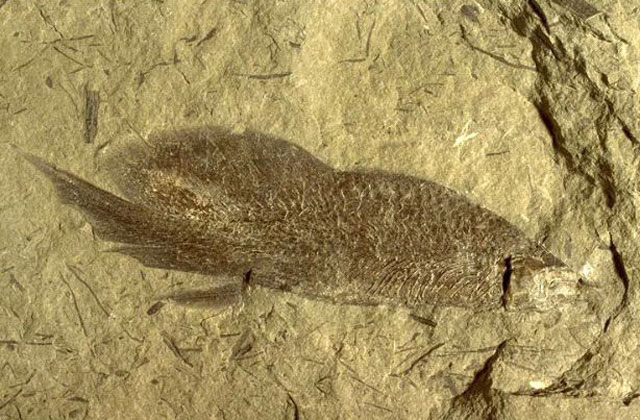
Title: Scaumenacia curta
Author: Parc national de Miguasha
Sources: Parc national de Miguasha
Year: 1996
Description:
A complete specimen of Miguasha’s dipnoan fish Scaumenacia curta. It is a relatively common species in the Escuminac Formation.